
The Great Migration
Happy Black History

I wrote this in 2018 for Black History Month for an online travel zine based in New York City, shortly after I came to Miami. I contributed a few more articles on Miami street art, Latin and Caribbean food. Wherever I go, there I am.
Dedicated with love and gratitude to my grandmother, Mary Catherine, who made her migration from Hayneville, Alabama with my two year old father, Howard Earl, to Ypsilanti, Michigan, 1939.
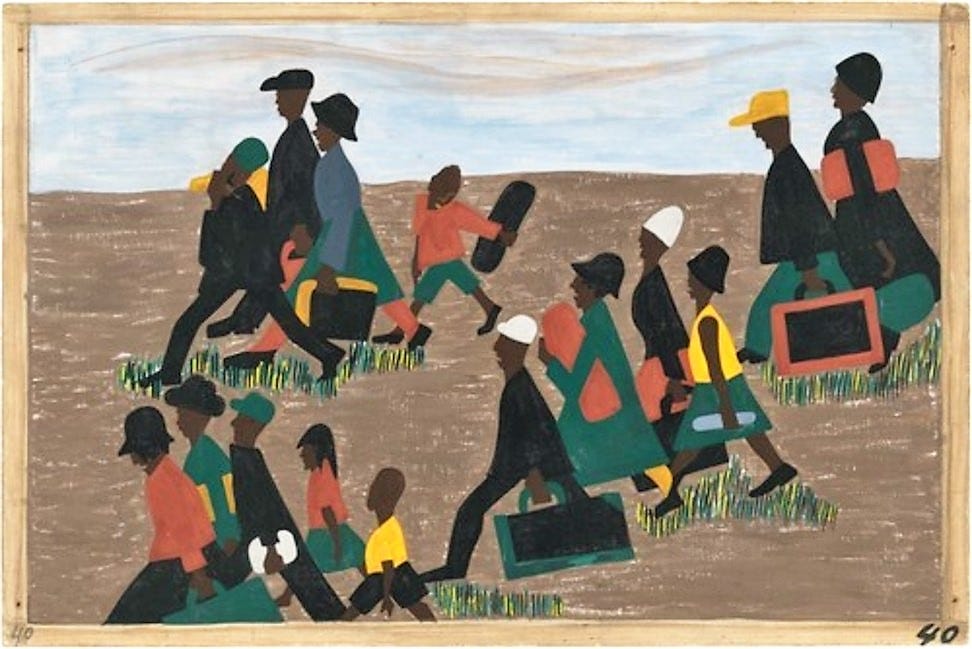
Exodus
We all have family stories that point to periods in African-American history. Consider if you’re from the Western US, you likely had ancestors who migrated West from Oklahoma, Louisiana, Arkansas, or Texas between the Great Depression and Great Migration. The former occurred in two waves from the early- to mid 20th century. Historians debate the time frame for each since the migrations were not formally recorded, although statistical data can be found to corroborate the increase of black populations in various Northern and Western cities between 1910 - 1970. Stories were also shared through oral history, family photos, and artifacts.
The First Great Migration began between 1910 - 1930 and the Second Migration at the onset of World War II, 1940 - 1970. Until 1910 about 90 percent of the African-American population lived in the South. The First Great Migration had 1.6 million people migrate to mostly industrial cities in the North.
The Second Great Migration saw a surge up to 5 million people, which by then had expanded west to California, Oregon, and other Western states.
The Economy of Jim Crow
There were several factors which precipitated the migration from the South beginning with agricultural economics and living in extreme poverty. Many Black folks at the time worked under a sharecropper system where they in effect paid rent to landowners for the crops they cultivated and harvested. This practice often kept farmers in continuous debt. If they needed a mule, livestock, or equipment to cultivate, the landowner would purchase it and the sharecropper would go further in debt against what crops he/she could yield. It was a cycle of exploitation and Black folks had no rights under the law and severely restricted access to loans making the purchase of land for themselves nearly impossible.
Positions in factories and industrial sectors of Northern cities also meant low pay, far below that of white workers, and conditions were often dangerous. Black women during this period worked primarily as domestics and cooks in white homes.
Another factor which spurred migration was living under the Jim Crow. These state and local laws enforced racial segregation, which were established by white Democrat (Dixiecrat) state legislatures in the 19th century after Reconstruction. These laws permeated all facets of public and private life - hospitals, schools, civic institutions, transportation, and businesses were segregated throughout the South. African-Americans had no rights or protections under Jim Crow. Black folks had to establish their own funeral homes and mortuaries due to segregation. Cemeteries, sacred spaces for the dead, were segregated under the law.
Under this oppressive system, people lived under constant stress from the threat of violence, lynching, abuse, and exploitation. They had to become self-sufficient and created their own markets, trades, and local businesses. Even then, a Black business could be burned out or dismantled legally if considered a threat to white business owners or what was referred to as the greater good.
The irony of this is that Black patrons were often banned from supporting their own people so that white businesses could flourish, even if their product or service was substandard. Although Northern cities were also segregated, there were still better opportunities and wages to be found in addition to more adequate housing. At the beginning of the 20th century, the South largely remained an agriculture-based economy. The North experienced an industrial boom and found a labor shortage. Businesses and manufacturers looked to the labor class of the South:
By 1920 post-war economic growth and a large migration of Southerners to the industrialized North had nearly doubled the city’s population to 993,678, an overall increase of 113% from 1910. Most startling, at least for white Detroiters, was the growth of the city’s black population to 40,838, with most of that growth occurring between 1915 and 1920. By the end of World War I over 8,000 black workers were employed in the city’s auto industry, with 1,675 working at Ford Motor Company. - TheHenryFord.org, Collections and Research
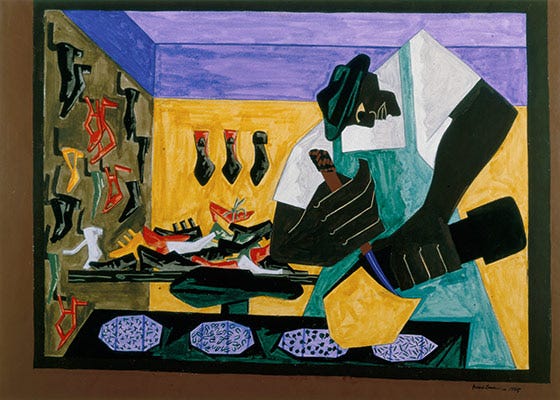
I pick up my life
And take it with me
And I put it down in
Chicago, Detroit,
Buffalo, Scranton…
I pick up my life
And take it on the train
To Los Angeles, Bakersfield
Seattle, Oakland, Salt Lake,
Any place that is
North and West ---
And not South.
‘ - Langston Hughes, One-Way Ticket, 1949
The African Face of the North
The First and Second Great Migrations had a profound impact on the culture and demographics of Northern American cities. Until that point, these were primarily European immigrant settlements which characterized cities like Milwaukee, Chicago, New York, Philadelphia, and Boston.
Southern black migrants established communities in Detroit, the Roxbury section of Boston, Harlem in New York, the South sides of Chicago and Philadelphia, the Bayview and Fillmore of San Francisco, and West Oakland in the Bay Area. Southern cuisine and church life were interwoven into these communities, following the Baptist and Methodist traditions of the South. West Oakland had its largest black population during the Second Great Migration when the shipyards of the Bay Area had an employment boom during World War II. Black folks settled into what became a thriving area of the city with jazz clubs, restaurants, and local businesses along the 7th Street corridor. The Black Panther Party was established in West Oakland, October 15th, 1966.
In 1934 the Federal Housing Authority implemented the red-lining system, where blacks were restricted to certain neighborhoods within US metropolitan areas, including the San Francisco Bay Area. Red-lining was designed to keep black communities contained to protect white property value and affluence. Although California banks who would serve black applicants were limited, folks were able to apply for home loans and purchase property.
Despite the civic and financial restrictions of where black folks could live, they still had the opportunity to chart their own path, however difficult the endeavor. For many, a new life in Los Angeles, Boston, New York, or Seattle still represented freedom from the oppression they had escaped from. As a result of the Great Migration, Detroit became a major African-American city with a population of 82.7% in the 2010 census, dropping to 75.3% by 2020.
The Harlem Renaissance became the cultural and artistic center of black life in New York City between 1918 to the mid-1930s. It was in Harlem that painters, writers, musicians, and scholars found community; many coming from the First Great Migration. The largest population of Southern blacks in the country settled in this area of Upper Manhattan, which was previously a Dutch settlement.
What is extraordinary about the Great Migration is that it is the story of us and our American experience. Each one of us can chart an ancestor from a point in Africa to the New World, to a slave, to a Southern migrant, and ending in the place where you were born. We are the living embodiment of our ancestors through family photos, stories of struggle and adaptation, long treks by car, bus or rail, in the pursuit of freedom within our own country. The history of a people on the move. You can read more about the Great Migration and first hand narratives in the The Warmth of Other Suns by Isabel Wilkerson.
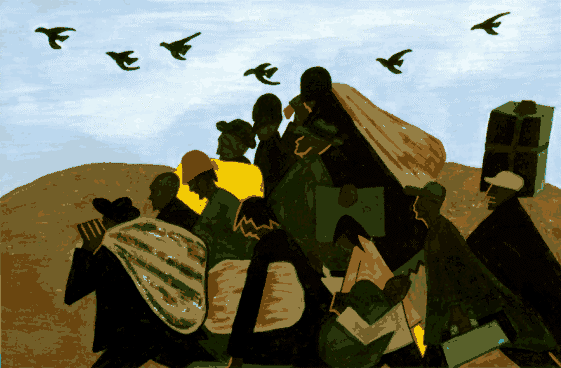
Blackbird singing in the dead of night
Take these broken wings and learn to fly
All your life
You were only waiting for this moment to arise
Blackbird singing in the dead of night
Take these sunken eyes and learn to see
All your life
You were only waiting for this moment to be free
Blackbird fly, blackbird fly
Into the light of the dark black night
Blackbird fly, blackbird fly
Into the light of the dark black night
Blackbird singing in the dead of night
Take these broken wings and learn to fly
All your life
You were only waiting for this moment to arise.
- Lennon /McCartney, © Blackbird, 1968
❤️❤️❤️